Knicks News
Knicks Blockbuster Trade Idea Sends Josh Hart to Lakers and Brings Jalen Duren to New York
Published
3 minutes agoon
By
knicksnews
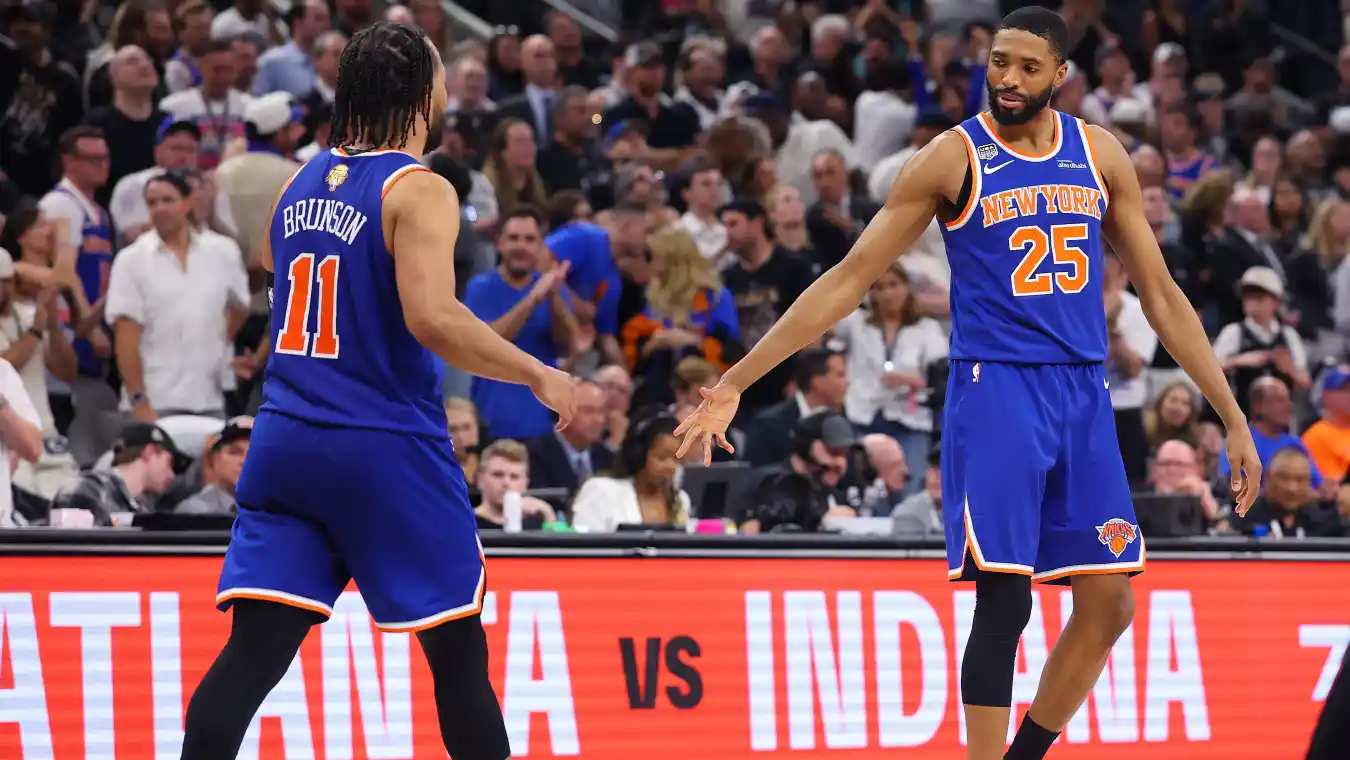
A proposed four-team trade would send Josh Hart to the Lakers and Mikal Bridges to Detroit while bringing Jalen Duren to the Knicks. Would New York really break up its championship core?
The New York Knicks have spent the summer protecting a championship roster rather than dismantling it. That is why any trade involving Josh Hart or Mikal Bridges would have to offer something substantial in return.
One speculative four-team framework certainly qualifies.
The proposal would send Hart to the Los Angeles Lakers, Bridges to the Detroit Pistons and bring Jalen Duren to New York on a new four-year, $167.2 million contract. The Knicks would also receive Jake LaRavia, Taurean Prince and three future second-round picks, while the Lakers would add Hart and Garry Harris. The Clippers would receive Dalton Knecht and Jaden Hardy.
There is no indication that such a deal is being negotiated. It is a theoretical construction designed to address several roster questions at once. But from the Knicks’ perspective, it raises a fascinating debate: Would acquiring one of the NBA’s most promising young centers justify breaking apart two major pieces of a championship core?
That is where the proposal becomes much more complicated than simply identifying Duren as an attractive target.
Jalen Duren Would Solve the Knicks’ Biggest Long-Term Frontcourt Question
The basketball argument for Duren is easy to understand.
New York lost Mitchell Robinson in free agency and replaced part of his rebounding and physicality with veteran Andre Drummond. Karl-Anthony Towns remains the starting center, but the Knicks still lack a young interior player who could anchor the position for the next several seasons.
Duren would immediately change that equation.
Still only in his early 20s, he has already developed into one of the league’s most productive young big men. His combination of rebounding, rim pressure, athleticism and interior finishing would give New York something very different from Towns.
Theoretically, Mike Brown could use Duren as a traditional center while allowing Towns to spend more possessions away from the basket. Against bigger opponents, the Knicks would have the option of playing both together. Against smaller lineups, Duren could protect the rim while New York surrounded him with shooting and perimeter defense.
The appeal is even greater when considering the future.
Towns is already one of the most expensive players on the roster, while the Knicks must continue making difficult decisions around extensions for Hart, Jalen Brunson, OG Anunoby and others. Adding a 22-year-old center with All-Star upside could give New York another foundational player who remains productive well beyond the current championship window.
But the proposed price is enormous.
New York would be giving up Bridges and Hart, two players whose value goes far beyond traditional statistics.
Bridges provides elite availability, perimeter defense, shooting and lineup versatility. Hart is one of the emotional engines of the team, an elite rebounder for his size and a secondary playmaker who can influence games without requiring offensive touches.
They were not peripheral pieces during the championship run.
They were part of the formula.
That makes Duren’s talent only half of the discussion.
Sending Hart to the Lakers Could Cost New York More Than the Payroll Savings Are Worth
The Lakers’ interest in Hart would make sense in almost any context.
Los Angeles is trying to construct a new roster around Luka Doncic after the departure of LeBron James, and Hart is exactly the type of complementary player who can make a superstar-led lineup function more efficiently.
He does not need the ball to contribute.
Hart rebounds, defends multiple positions, pushes the pace and creates transition opportunities immediately after defensive rebounds. Put him next to Doncic and the Lakers would gain another player capable of covering difficult assignments while keeping the offense moving without demanding high usage.
That is precisely why the Knicks should be reluctant to move him.
New York already knows Hart fits beside Brunson, Towns, Bridges and Anunoby. It knows how he performs under postseason pressure. More importantly, he has repeatedly expressed how comfortable he is in New York and how much he values remaining part of the franchise.
Breaking up that chemistry for financial reasons would carry significant risk.
The same applies to Bridges.
Sending him to Detroit would help the Pistons resolve the uncertainty around Duren and replace some of the veteran production lost elsewhere, but New York would be surrendering perhaps the most reliable two-way wing on its roster.
That would dramatically alter the Knicks’ identity.
The proposal therefore creates an unusual trade-off.
New York would solve its long-term center problem while simultaneously creating new questions on the perimeter. Duren would improve the frontcourt, but Brown would suddenly need replacements for two starters who help define how the Knicks defend, rebound and transition between lineups.
There is also the financial component.
A four-year, $167.2 million contract for Duren would hardly qualify as inexpensive. The deal may be designed to reshape New York’s salary structure, but acquiring Duren on a contract worth more than $40 million annually would represent another major long-term commitment.
Any actual transaction involving a sign-and-trade would also have to satisfy the NBA’s complicated apron and salary-matching rules, making the theoretical framework much easier to draw on paper than to execute in reality.
That is why the proposal works better as a thought experiment than an obvious Knicks solution.
Duren is exactly the type of player New York should monitor if he ever becomes genuinely available. Young, productive centers with his athletic profile rarely reach the market.
But there is a difference between wanting Duren and being willing to dismantle the structure of a championship team to acquire him.
The Knicks have already demonstrated that Hart and Bridges work alongside their stars.
Duren represents upside.
Hart and Bridges represent proof.
For a defending champion, surrendering two proven championship pieces for even an elite young center would require far more than an intriguing trade machine scenario. It would require New York to believe Duren can become one of the defining players of its next era.
You may like
-
Knicks’ Next Championship Move May Not Be a Trade — It Could Be Developing Their Own Cheap Talent
-
Knicks May Have to Lose More to Win Again: Why Mike Brown Could Sacrifice Seeding for Another Title
-
Knicks Don’t Need a Klay Thompson Rescue: New York Already Built the Depth Miami Is Trying to Recover
-
Jalen Brunson’s Earliest Known Autograph Is Up for Auction — and His Childhood Message Feels Almost Prophetic
-
Knicks Have a Hidden Development Decision: Manny Obaseki Could Be Westchester’s Next Long-Term Bet
-
Josh Hart’s Next Knicks Deal Could Get Expensive: Why $60 Million May No Longer Be Enough
Knicks News
Knicks’ Next Championship Move May Not Be a Trade — It Could Be Developing Their Own Cheap Talent
Published
2 hours agoon
08/24/2026By
knicksnews
The Knicks’ title window may depend on developing Mohamed Diawara, Pacome Dadiet and other young players as New York navigates the second apron and rising salaries.
The New York Knicks have already reached the top of the NBA. Staying there could require a very different type of roster-building success.
New York’s championship core is expensive and will only become more costly over the next year. Karl-Anthony Towns, Josh Hart, Jalen Brunson and OG Anunoby all have major contractual decisions approaching, while the organization has shown a clear desire to avoid crossing the second apron whenever possible.
That reality already influenced the roster this summer. The Knicks lost Mitchell Robinson in free agency rather than pushing their payroll structure into a more restrictive tier.
For that reason, player development is no longer just a secondary organizational objective. It may become one of the most important ways for New York to extend its title window.
Players such as Mohamed Diawara, Pacome Dadiet and Tyler Kolek do not need to become stars. If even one or two of them grow into dependable rotation pieces on inexpensive contracts, the financial value to the Knicks could be enormous.
Diawara and Dadiet could become more valuable than another expensive veteran
The easiest way for a contender to survive an expensive core is to find production below market value.
That is where young players matter.
Veteran role players who can defend, shoot and survive playoff minutes are increasingly expensive. The Knicks may not always have the financial flexibility to replace every departing rotation player with an established name.
A prospect such as Diawara therefore represents more than developmental upside.
If he becomes a reliable forward capable of defending multiple positions, rebounding and making enough open shots to stay on the floor, New York could fill 15 to 20 regular-season minutes without spending heavily in free agency.
Dadiet faces a similar opportunity.
The former first-round pick still needs to prove he can translate his physical tools and offensive flashes into consistent NBA production, but his age and contract situation make him exactly the kind of player the Knicks need to develop.
This is the larger challenge facing the front office.
The championship roster cannot simply become more expensive every summer while New York continues importing proven veterans. At some point, internal growth has to replace external spending.
And that process matters even more after Robinson’s departure.
Losing him was not only about losing rebounding and rim protection. It illustrated the cost of maintaining a championship roster under the NBA’s current financial system.
The Knicks were forced to make a choice.
There will be more choices like it.
The second apron makes development part of New York’s title-defense strategy
The second apron has changed the way elite teams must think.
It is no longer merely a luxury-tax threshold. It can affect roster flexibility, trades and the ability to add talent around an expensive core.
That makes cheap internal production extraordinarily valuable.
If Diawara, Dadiet, Kolek or another young player develops into a legitimate rotation option, New York gains flexibility in two ways.
First, the Knicks avoid having to spend veteran-level money for that role.
Second, they preserve more resources for the stars who define their championship window.
That becomes especially important with Towns, Hart, Brunson and Anunoby all carrying major extension implications over the next 12 months.
New York does not have to retain every player at any cost, but the organization will inevitably have to decide which members of the core are essential and where savings can be found elsewhere.
Young players can become those savings.
This is why the development staff may be nearly as important as the front office over the next two seasons.
A title contender usually thinks in terms of playoff matchups, trades and veteran upgrades. The Knicks now have to think in another direction as well: Which young player can become good enough that New York does not need to spend $10 million or $15 million to replace him?
That is the hidden value of development.
Diawara does not need to become OG Anunoby. Dadiet does not need to become Mikal Bridges. Kolek does not need to become Brunson.
They simply need to become useful enough that Mike Brown trusts them.
If that happens, the Knicks can protect their stars, keep the regular-season rotation deeper and maintain greater flexibility under the apron.
If it does not, the cost of preserving this championship roster will become increasingly difficult to manage.
The Knicks have already proven they can build a title team.
Their next challenge is proving they can develop enough inexpensive talent to keep it together.
Knicks News
Knicks May Have to Lose More to Win Again: Why Mike Brown Could Sacrifice Seeding for Another Title
Published
3 hours agoon
08/24/2026By
knicksnews
The Knicks may sacrifice regular-season wins and a higher playoff seed to protect their stars, giving Mohamed Diawara and Tyler Kolek larger roles in New York’s title defense.
The New York Knicks spent last season proving that the best regular-season record is not always the most important objective for a championship team. Now that they are defending the title, Mike Brown may lean even further into that philosophy.
According to Zach Braziller of the New York Post, New York could be willing to sacrifice some regular-season wins and potentially accept a lower playoff seed if it means arriving in April healthier and fresher. The logic is straightforward: the Knicks already know they can win without exhausting their core over 82 games, and repeating as champions will require managing wear just as carefully as managing the standings.
That approach worked last season. New York finished 53-29 and third in the Eastern Conference, then went 16-3 in the playoffs on the way to the championship. Brown used a deeper rotation than the Knicks had been accustomed to in previous years and reduced the workload on several starters, prioritizing freshness over chasing every available regular-season win.
The next step may be even more aggressive — and that could create meaningful opportunities for players such as Mohamed Diawara and Tyler Kolek.
Brown Could Trade a Few Wins for Healthier Stars in April
The Knicks’ championship window revolves around Jalen Brunson, Karl-Anthony Towns, OG Anunoby, Mikal Bridges and Josh Hart.
All five remain central to New York’s chances of repeating, but that also means the organization has a strong incentive to avoid unnecessary mileage. There is little value in winning 58 or 60 regular-season games if the cost is entering the postseason with a worn-down roster.
Brown appears to understand that calculation.
The Knicks already demonstrated last season that reduced minutes do not necessarily prevent them from securing a favorable playoff position. They still posted the third-best record in the East while preserving their core well enough to produce one of the most dominant postseason runs in recent league history.
That balance will be even more important this season.
Defending champions typically face more demanding schedules, more national attention and opponents that treat regular-season matchups like statement games. The Knicks will also be managing an older frontcourt after replacing Mitchell Robinson with Andre Drummond, making workload management even more important across the roster.
The likely consequence is simple: there will be nights when Brown chooses development over maximum short-term efficiency.
A back-to-back in January may not require Brunson to play 38 minutes. Anunoby and Bridges may not need to absorb every difficult wing matchup in November. Towns may be held out of certain stretches if there is even minor physical concern.
Those decisions could cost New York a few games.
But if the reward is a healthier rotation in May, the tradeoff becomes easy to understand.
Diawara and Kolek Could Become Essential to the Repeat Plan
The biggest beneficiaries may be New York’s younger players.
Diawara appeared in 69 regular-season games last year, averaging 9.2 minutes while shooting 36.9% from three. Kolek played 62 games and averaged 11.7 minutes, 4.4 points and 2.7 assists while hitting 38.6% from deep.
Neither was a major playoff contributor, but that does not diminish their potential value during the regular season.
In fact, this may be precisely where they matter most.
Diawara gives Brown a long, athletic 6-foot-9 forward who can defend multiple positions and absorb minutes that might otherwise fall to Anunoby or Bridges. His offensive game remains a work in progress, but his defensive tools alone could make him useful during stretches where New York wants to protect veteran workloads.
Kolek offers a different type of relief.
He is a natural playmaker who can organize the offense, run pick-and-rolls and handle possessions without requiring Brunson to control every trip. His 2.7 assists in fewer than 12 minutes per game last season hinted at why the Knicks continue to value him as a developmental guard.
The question for both players is whether they can become reliable enough that Brown trusts them in meaningful regular-season minutes rather than only low-leverage situations.
That is where the title-defense strategy becomes interconnected.
If Diawara, Kolek and other young players improve, the Knicks can rest their stars more aggressively without giving away too much in the standings. If the young bench struggles, Brown may be forced back toward heavier workloads and shorter rotations.
This is why development is not a side project for New York.
It is part of the championship plan.
The Knicks do not need Diawara or Kolek to become playoff stars overnight. They need them to be good enough in December, January and February to keep Brunson, Anunoby, Bridges and Towns from carrying unnecessary minutes.
That may mean New York drops from third to fourth in the conference.
It may mean fewer dramatic regular-season wins.
But after last season, the organization has already learned the most important lesson: April health matters more than January standings.
The Knicks are no longer trying to prove they belong among the contenders. They already won the championship.
Now the goal is to arrive at the postseason with enough energy to do it again.
Knicks News
Jalen Brunson’s Earliest Known Autograph Is Up for Auction — and His Childhood Message Feels Almost Prophetic
Published
6 hours agoon
08/24/2026By
knicksnews
Jalen Brunson’s earliest known autograph has surfaced at auction, featuring a remarkable childhood “1 of 1” message after his historic Knicks championship and Finals MVP run.
Jalen Brunson has spent the summer celebrating the biggest achievement of his career. He delivered a championship to the New York Knicks, won NBA Finals MVP and completed one of the most memorable playoff runs in franchise history.
Now, an artifact from long before Madison Square Garden has surfaced — and it makes Brunson’s rise look almost scripted.
An autograph believed to be the earliest known signature from Brunson has been listed for auction. It comes from his middle school yearbook and features his name written in cursive alongside the No. 13 he wore at the time.
The most striking detail, however, is what Brunson added next to his signature: “1 of 1.”
For a player who would eventually become the centerpiece of a Knicks championship team, the message has taken on an entirely different meaning. What once looked like the confidence of a kid now reads almost like an early declaration of what Brunson believed he could become.
Brunson’s “1 of 1” Message Looks Different After a Historic Knicks Run
Sports memorabilia is often valuable because of rarity. In Brunson’s case, this piece carries something more compelling: context.
The yearbook autograph predates the Villanova championships, the NBA Draft, his early years in Dallas and certainly his transformation into the face of basketball in New York.
At the time, Brunson could not have known exactly where his career would take him.
Yet the “1 of 1” inscription feels unusually appropriate after what happened during the 2026 postseason.
Brunson led the Knicks to their first NBA championship in 53 years and captured Finals MVP after averaging 32.6 points per game against the San Antonio Spurs. His defining performance came in Game 5, when he scored 45 points as New York closed out the series and finally ended more than five decades of championship frustration.
That victory completed a dominant postseason.
The Knicks finished the playoffs 16-3, recovering from a 2-1 deficit against Atlanta before producing a remarkable 13-game winning streak. New York then swept Philadelphia and Cleveland before defeating San Antonio in five games in the NBA Finals.
Even the one Finals loss did not break the Knicks.
San Antonio appeared ready to completely change the series in Game 4 when it built a 29-point advantage. Instead, New York produced an extraordinary comeback, escaped with the victory and took a commanding 3-1 series lead.
Brunson was at the center of everything.
His ability to control late-game possessions, generate offense under pressure and consistently respond when the Knicks needed a basket turned him from franchise star into championship icon.
That transformation is what makes the childhood autograph so compelling.
It is not simply an old signature from a famous athlete. It is a snapshot of Brunson before anyone knew whether the confidence behind “1 of 1” would ever become justified.
Now it has.
The Auction Offers Knicks Fans a Rare Piece of Brunson History
For collectors, early-career memorabilia often carries a different level of fascination than modern autographs.
Current Brunson signatures are relatively accessible through cards, jerseys and officially licensed memorabilia. A middle school yearbook signature is something entirely different.
If confirmed as his earliest known autograph, the item becomes a unique piece of the personal history of one of the most important players the Knicks have ever had.
Its timing could hardly be better.
Brunson enters the next season not merely as New York’s captain and offensive leader, but as a NBA champion and Finals MVP. His place in Knicks history changed permanently during the 2026 postseason.
That inevitably changes the market around his memorabilia as well.
Championship moments create permanent reference points for collectors. Items connected to a player before he became famous can become particularly attractive because they capture a period that cannot be recreated.
And Brunson’s autograph contains a detail no newly signed jersey can reproduce.
The words “1 of 1” provide the story.
They reveal a young athlete already carrying the confidence that would eventually become one of his defining NBA traits. Brunson has never played with the outward theatrics associated with some superstars, but his belief in his own ability has always been central to his rise.
He was overlooked relative to bigger prospects, entered the league without the profile of a future franchise player and eventually became the man New York trusted to end a championship drought that had lasted since 1973.
The next chapter begins on October 20, when the Knicks open their title defense at Madison Square Garden against Philadelphia.
Brunson will enter his fifth season in New York under completely different circumstances than any of the previous four.
The question is no longer whether he can become a Knicks star.
It is how much more he can add to a legacy that already includes a championship, a Finals MVP trophy and one of the greatest postseason runs in franchise history.
And somewhere in a middle school yearbook, a young Brunson apparently had his own answer long before anyone else did:
1 of 1.