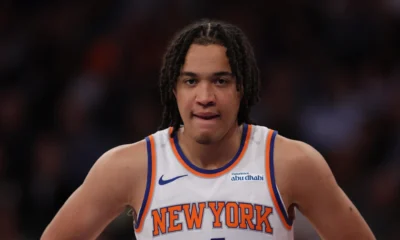
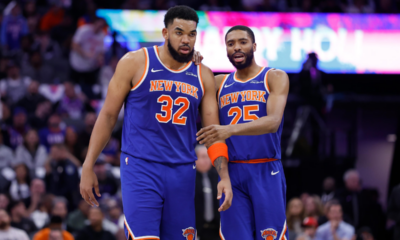
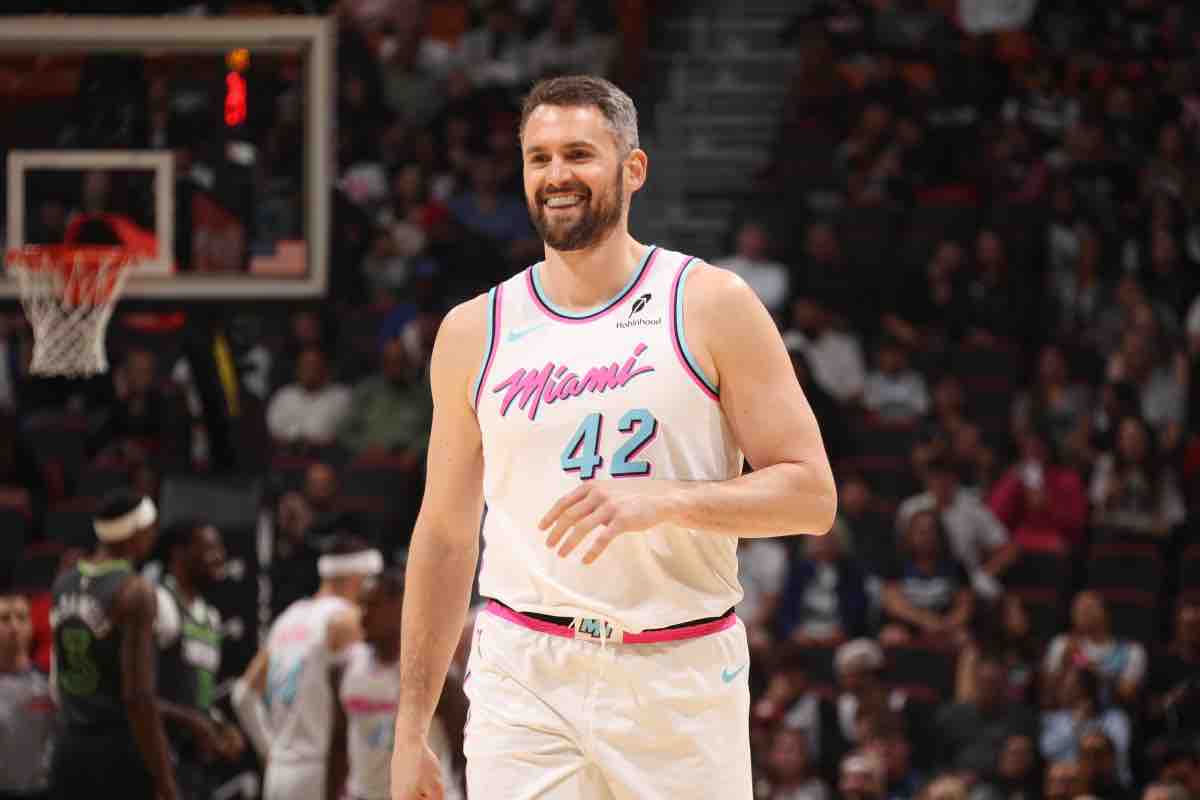
Kevin Love remains a potential Knicks free-agent option. His rebounding, experience and floor-spacing ability could help New York replace part of what it lost with Mitchell Robinson.
The New York Knicks are not going to replace Mitchell Robinson with another Mitchell Robinson. His combination of offensive rebounding, physicality and interior defense was too specific to replicate with one inexpensive late-summer signing.
What New York can do, however, is replace parts of his impact in different ways.
That is what makes Kevin Love an intriguing veteran option for the defending champions. The five-time All-Star remains an unrestricted free agent after spending last season with the Utah Jazz, where he averaged 6.7 points and 5.8 rebounds per game.
At 37, Love is clearly no longer the All-NBA-level player who once averaged more than 20 points and 15 rebounds in Minnesota. His defensive limitations would also prevent him from filling Robinson’s role as a traditional rim protector.
But that does not mean he could not help the Knicks.
In a limited bench role, Love would offer New York something its current collection of big men does not necessarily provide: rebounding combined with legitimate shooting range from the frontcourt. For a team already featuring Karl-Anthony Towns, that flexibility could open some unusual lineup combinations for Mike Brown.
Kevin Love Would Replace Rebounding Differently Than Robinson
Robinson’s departure created an obvious question for New York.
Who replaces those extra possessions?
Robinson was one of the Knicks’ most valuable offensive rebounders, capable of extending possessions without needing plays called for him. Love would not reproduce that impact through athleticism or above-the-rim play, but rebounding has been one of the defining skills of his career.
Even with his minutes reduced last season, Love still averaged 5.8 rebounds per game, a respectable number considering his limited role.
His approach is also different from Robinson’s.
Love has always relied heavily on positioning, anticipation and physical box-outs. That becomes especially relevant as players age because it is a skill that does not depend entirely on explosiveness.
For the Knicks, he would not need to play 25 minutes every night. The value would come from being able to enter games for short stretches, stabilize the defensive glass and create additional possessions without requiring the ball offensively.
There would obviously be a trade-off.
Robinson gave New York vertical rim protection. Love does not. At this stage of his career, asking him to defend mobile centers or survive repeated pick-and-roll actions would create problems.
That makes the fit highly matchup-dependent.
But New York already has Towns and Andre Drummond available at center. Love would not need to become the primary backup five. Instead, he could function as another tactical option at both power forward and center.
Love’s Shooting Could Give Mike Brown Another Small-Ball Weapon
This is where the argument for Love becomes more interesting.
Unlike Robinson — and unlike Drummond — Love forces opposing defenses to respect him away from the basket.
That shooting ability completely changes the geometry of an offense.
New York could theoretically use Love as a stretch five in lineups built around Brunson and multiple perimeter creators, opening the paint and forcing opposing centers away from the rim. He could also play alongside another big as a floor-spacing power forward.
Even in limited minutes last season, Love continued to demonstrate that he remains willing and capable from deep. NBA.com’s game logs included flashes of that shooting ability, including a March performance in which he hit all three of his three-point attempts while adding eight rebounds in just 15 minutes.
That combination of shooting and rebounding has already made Love one of the veteran centers mentioned as a possible option for New York this offseason. A recent examination of remaining Knicks targets specifically included him among the free-agent big men still capable of filling a depth role.
The appeal is easy to understand.
The Knicks do not need another star. They need players who can solve specific problems without disrupting the established hierarchy.
Love understands that type of role.
He has already transitioned from franchise cornerstone to complementary veteran over the later stages of his career. Playing 10 or 15 minutes one night and potentially sitting the next would presumably be easier to manage with a player accustomed to changing responsibilities.
There is also the championship factor.
Love already owns a ring from Cleveland’s 2016 championship run. Joining the defending champions in New York would give him another opportunity to compete deep into the postseason while giving the Knicks another player familiar with the pressure surrounding a title defense.
The move would certainly carry risks. Love’s defense could be targeted in playoff matchups, and the Knicks would need to protect him with the right lineup combinations. He also cannot be viewed as a direct answer to New York’s need for rim protection.
But that may be the wrong way to evaluate him.
Kevin Love would not replace Mitchell Robinson. He could help replace some of the things the Knicks lost when Robinson left — while adding an offensive dimension Robinson never provided.
For the right price and the right role, that could make him one of the more interesting remaining free agents for a Knicks team looking for small upgrades rather than another major overhaul.