Knicks Could Keep Their Championship Core for Five Years — but One Contract May Ruin Everything
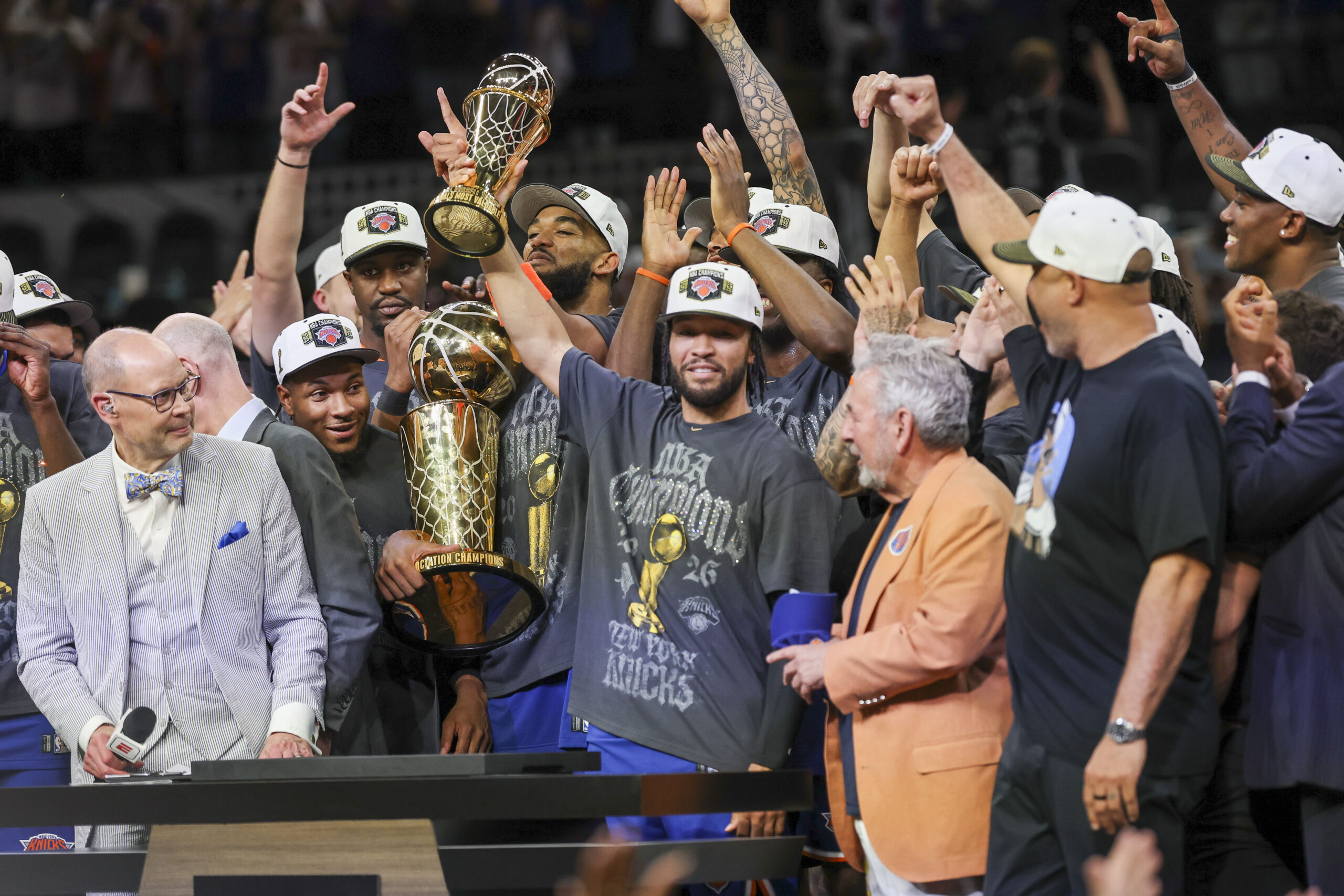
Jun 13, 2026; San Antonio, Texas, USA; New York Knicks guard Jalen Brunson (11) celebrates with his teammates after the Knicks defeat the San Antonio Spurs during game five of the 2026 NBA Finals at Frost Bank Center. Mandatory Credit: Geoff Burke-Imagn Images
The Knicks could preserve their championship core for up to five seasons, but extensions for Towns, Hart, Brunson and Anunoby threaten their second-apron plan.
The New York Knicks ended a 53-year championship drought in commanding fashion, immediately shifting the conversation from whether this group could win to how long it might remain together. With Mitchell Robinson representing the only major departure from the title rotation, New York will enter 2026-27 with continuity, confidence and another realistic opportunity to reach the NBA Finals.
The window should remain open for at least two more seasons. Josh Hart, the oldest regular member of the rotation, is only 31, while Jalen Brunson, Karl-Anthony Towns, OG Anunoby and Mikal Bridges remain near their competitive primes.
Keeping them together beyond that point will require precise financial management. The second apron has already prevented the Knicks from matching Boston’s offer to Robinson, and it will continue influencing every extension, trade and roster decision made by Leon Rose.
New York has secured some important supporting pieces. Bridges is under contract for three more seasons, while José Alvarado and Landry Shamet have also received multiyear commitments. The immediate uncertainty now surrounds Towns, Hart and Miles McBride.
Towns and Hart Hold the Keys to the Knicks’ Immediate Window
Towns has a $61 million player option for the season after 2026-27 and can negotiate a new extension with New York. Following his outstanding championship run, he has a strong argument for another lucrative contract, but accepting his full potential maximum—nearly $70 million annually—would create major problems for the Knicks.
An extension worth approximately $50 million per season could represent a workable compromise. Towns would gain long-term security beyond his prime years, while New York would preserve additional room below the second apron.
If no agreement is reached, the Knicks could eventually face an uncomfortable choice between trading Towns and risking his departure in free agency. Neither option would be attractive for a team trying to defend a championship.
Hart’s situation carries similar significance on a smaller financial scale. New York holds a $22.3 million team option for next season, and the forward is already eligible for an extension. A three-year agreement worth approximately $20 million annually has been discussed as a possible middle ground.
Hart might receive larger offers elsewhere, but his connection with Brunson and importance to New York’s culture make a departure difficult to imagine. His rebounding, transition play and positional flexibility allow him to influence games without requiring a major offensive role.
The risk comes at the end of the contract. Hart’s energetic style places substantial physical demands on his body, and the Knicks could be paying for declining seasons as he moves deeper into his 30s. Even so, preserving his chemistry and versatility may justify accepting that long-term concern.
If Towns and Hart agree to manageable extensions, New York should be capable of maintaining most of its championship rotation through at least the next two seasons.
McBride’s Future Could Signal the Beginning of the Breakup
McBride represents a different challenge because the Knicks failed to reach an extension with him before the deadline. He will enter the season on an expiring $3.9 million contract and could command a significant raise in free agency.
New York has benefited enormously from McBride’s team-friendly salary. His perimeter defense, improved shooting and postseason reliability have made him one of the league’s best-value reserve guards. Paying his market price, however, could make it nearly impossible to retain the more expensive members of the rotation without crossing the second apron.
That creates a strong argument for exploring trades before the deadline. Teams interested in acquiring McBride’s Bird rights may be willing to offer a younger player on a rookie contract, another affordable contributor or draft compensation. Otherwise, the Knicks risk losing him without receiving anything in return.
Tyler Kolek represents the most immediate internal replacement, while Jack Kayil will continue developing overseas during the 2026-27 season. Neither is guaranteed to reproduce McBride’s two-way contribution, but expensive teams must regularly replace productive role players with cheaper talent.
The financial pressure will become even greater in 2028-29, when Brunson could begin a maximum extension worth more than $70 million per season. Anunoby can also reach a decision point around 2029, when his contract includes a $48 million player option.
To preserve the starting five deep into the decade, the Knicks may need Anunoby and Bridges to remain closer to the $40 million-to-$45 million range while Towns stays near $50 million. If one or more players demand significantly higher salaries, the numbers could become unsustainable.
Age may eventually resolve the issue naturally. By that stage, the core will consist largely of players in their early-to-mid 30s, and injuries or declining performance could make a retool more logical than another round of expensive extensions.
If the group remains capable of winning, though, New York could theoretically keep it together for as many as five seasons by controlling extension values and continually replenishing the bench with draft picks, minimum contracts and internally developed players.
The Knicks have already accomplished something many believed impossible. Extending the run into a multi-year championship window is achievable, but only if loyalty, financial sacrifice and smart development continue working together. One overly expensive contract could disrupt the entire structure.