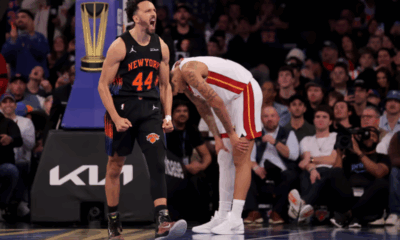
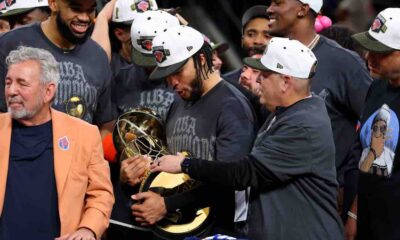
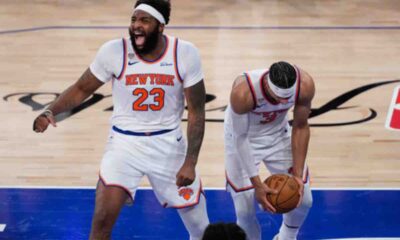
The New York Knicks could turn to Tyler Nickel and Mohamed Diawara if Landry Shamet leaves in free agency, giving Mike Brown two young options to reshape the second unit.
The New York Knicks may soon face one of the more delicate decisions of their offseason. Landry Shamet proved his value during the championship run, giving Mike Brown reliable shooting, smart movement and important playoff minutes. But with the organization determined to manage its payroll carefully and avoid costly apron complications, keeping him may not be simple.
That is where Tyler Nickel becomes interesting.
Selected by New York with the No. 47 pick, Nickel arrives as the kind of specialist who can immediately make sense in a specific role. At 6-foot-6, he brings size on the wing and, most importantly, a proven shooting résumé. Across stops at North Carolina, Virginia Tech and Vanderbilt, Nickel shot 39.4 percent from three-point range over 127 college games. He also converted 84.7 percent from the free-throw line, another encouraging sign that his touch should translate.
Replacing Shamet completely would be unfair to expect from a rookie. Shamet gave the Knicks more defensive toughness and veteran understanding than his box scores often showed. Nickel is not the same type of defender, nor is he an explosive athlete. But New York does not need him to become Shamet overnight.
What the Knicks need is spacing. When Shamet hit shots in the playoffs, the entire offense breathed differently. Defenses had to respect him away from the ball, creating more room for Jalen Brunson, Karl-Anthony Towns and the rest of the starting core to operate. Nickel’s off-ball instincts and quick-release shooting could give New York a similar pressure point from the bench.
If defenders lose track of him, he can punish them. If they stay attached, he creates wider driving lanes for others. For a team built around elite decision-makers, that kind of simple, repeatable skill carries real value.
Diawara could offer a higher-upside answer
Mohamed Diawara may be the more complete long-term swing.
Unlike Nickel, Diawara already has NBA experience. His rookie season was uneven, as expected, and he spent much of the postseason outside the rotation. Still, when injuries opened a door during the regular season, he showed enough to make the Knicks believe there is something to develop.
His standout performance against the Boston Celtics was a glimpse of that potential. Diawara gave New York strong minutes, hit his shots and made a defensive impact against elite competition. At 6-foot-9, with length, mobility and flashes of shooting, he gives Brown a different type of bench piece than Shamet.
Diawara is not just a spot-up option. He has some ball-handling feel, passing instincts and defensive versatility. That makes him less polished than Shamet today, but potentially more flexible tomorrow.
The risk is obvious. Asking a second-year player to replace someone who contributed in Finals moments is dangerous. Young players rarely deliver consistent production immediately, especially on teams trying to defend a championship. But Diawara fits the profile of a player who can grow into a bigger role if the coaching staff trusts him.
If Shamet leaves, New York’s second unit would likely become younger and less predictable. That does not automatically make it worse, but it does make development more important. Nickel can provide shooting. Diawara can provide size, defense and upside. Together, they could give the Knicks enough internal cover to avoid overpaying in free agency.
The Knicks would still have flexibility. Just as they have done before, they could evaluate the roster during the season and pursue veteran help near the trade deadline if the bench needs reinforcement.
For now, the front office may already have its backup plan. Shamet’s departure would hurt, but Nickel and Diawara give New York two different paths toward replacing his impact — one through shooting, the other through versatility.