Connect with us

Knicks News

Miles McBride Is Entering the Most Important Season of His Knicks Career—and Nothing Will Be Guaranteed

Published

on

Miles McBride remains a valuable part of the New York Knicks, but his inconsistent NBA Finals and a crowded backcourt could force him to earn every minute during the 2026-27 season.

Championship teams are built on competition.

Not only against opponents, but within their own locker room.

That internal competition has become one of the defining characteristics of the New York Knicks under head coach Mike Brown. While continuity has been a major theme of the defending champions’ offseason, the battle for playing time may be fiercer than ever, particularly in one of the deepest backcourts in the NBA.

Few players illustrate that reality better than Miles McBride.

The veteran guard has earned the trust of the coaching staff through years of relentless defense, improved perimeter shooting and unwavering professionalism. Yet his postseason experience also demonstrated an important truth about Brown’s coaching philosophy: reputation alone will never guarantee minutes.

Every player must continue proving their value, regardless of past contributions.

The NBA Finals revealed how competitive New York’s rotation has become

For much of the playoffs, McBride remained a dependable part of New York’s rotation.

Across the first three postseason rounds, he averaged approximately 19 minutes per game and surpassed the 20-minute mark seven times in 14 contests. During that stretch, he contributed around seven points per game while knocking down 43 percent of his three-point attempts, providing valuable floor spacing and defensive intensity whenever Mike Brown turned to his bench.

Those performances reinforced why McBride has become such a respected role player.

However, the NBA Finals presented a dramatically different challenge.

As every possession carried greater importance, Brown shortened his rotation and leaned heavily on players who were producing consistently. McBride struggled to find his offensive rhythm during the series, failing to convert any of his eight field-goal attempts over the final three games.

His playing time reflected that decline.

Instead of maintaining his regular workload, his minutes dropped to roughly nine per game during the closing stretch of the Finals as Brown adjusted the rotation in search of the combinations that gave New York its best chance to secure the championship.

That decision was not necessarily an indictment of McBride.

Rather, it reflected the ruthless reality of championship basketball, where coaches cannot afford patience if another lineup offers a better opportunity to win.

McBride has the talent to respond, but consistency will be essential

There is important context surrounding McBride’s postseason struggles.

During a recent appearance on Knicks Film School, the guard revealed that he had played through significant discomfort after returning from the sports hernia surgery that sidelined him for much of February and March. Although he was medically cleared, he acknowledged that he never felt fully recovered during the playoffs.

That explanation provides valuable perspective.

Injuries can significantly affect rhythm, explosiveness and shooting mechanics, particularly for players whose roles depend on defensive intensity and confidence from beyond the arc. It is entirely reasonable to believe that a healthier McBride could return to the form he displayed before the postseason.

Even so, the competition around him has only intensified.

Jose Alvarado offers relentless defensive pressure and traditional point guard skills. Landry Shamet has become one of New York’s most reliable perimeter shooters and an excellent point-of-attack defender. Jordan Clarkson supplies instant offense whenever the second unit needs scoring, while Tyler Kolek continues developing as another intriguing option capable of handling backup guard responsibilities.

That depth gives Mike Brown tremendous flexibility.

Throughout last season, Brown repeatedly demonstrated that he is willing to experiment with lineups during the regular season and reward whichever players are performing at the highest level. Alvarado himself spent significant time outside the regular rotation before re-emerging as an important contributor during the playoffs, proving that roles can change quickly depending on performance and team needs.

McBride enters the new season fully aware of that reality.

If his outside shot remains consistent, if he continues expanding his ability to create offense off the dribble and if he maintains his reputation as one of the Knicks’ toughest perimeter defenders, there is little doubt he will remain an integral member of the rotation.

If those areas stagnate, however, the margin for error becomes much smaller.

With so many capable guards competing for minutes, a prolonged shooting slump or defensive inconsistency could result in a noticeable reduction in playing time.

That is not a weakness of New York’s roster.

It is one of its greatest strengths.

Championship teams thrive because every player understands that minutes must be earned rather than expected. The Knicks possess enough depth to adjust seamlessly from game to game, allowing Mike Brown to prioritize production over reputation.

For Miles McBride, that creates both a challenge and an opportunity.

His place on the roster is secure, but his role will ultimately be determined by what he produces on the court. If he responds with the same determination that has defined his career, the Knicks could once again find themselves relying on one of their most dependable two-way guards when the games matter most.

AdvertisementAdvertisement

Knicks News

Jose Alvarado and Jordan Clarkson Are the Knicks’ Secret Weapons for a Championship Repeat

Published

on

Jose Alvarado and Jordan Clarkson give the New York Knicks’ second unit energy, scoring and experience. Their contributions could be vital as the defending champions pursue another NBA title.

NBA championships are often defined by superstar performances, but they are rarely won without dependable role players.

The New York Knicks understand that reality better than most after their title-winning campaign. While Jalen Brunson, Karl-Anthony Towns and the rest of the starting lineup deservedly received the spotlight, the front office also recognized how important the second unit became throughout the season.

That is why Leon Rose made continuity a priority this offseason, ensuring Jose Alvarado and Jordan Clarkson would remain in New York.

Neither player headlines television broadcasts or dominates social media discussions, yet both fill roles that become increasingly valuable over the course of an 82-game season and an exhausting playoff run. In a league where the smallest details often separate champions from contenders, their presence could once again prove decisive.

Alvarado gives New York’s second unit a defensive identity

Jose Alvarado arrived in New York during last season’s trade deadline and immediately brought something the Knicks had been missing.

His relentless defensive intensity transformed the rhythm of the second unit.

Few guards in the NBA pressure opposing ball handlers as aggressively as Alvarado. His full-court defense forces mistakes, speeds up opponents and injects energy into games that sometimes become stagnant. That aggressive mentality perfectly complements Mike Brown’s philosophy of creating defensive pressure without sacrificing discipline.

During his first 28 games with the Knicks, Alvarado averaged 6.6 points and 3.8 assists while consistently influencing games in ways that extended far beyond the box score.

Recognizing his impact, New York rewarded him with a three-year, $14.4 million contract, a deal that reflects the organization’s confidence in his ability to remain an integral part of the championship rotation.

What makes Alvarado especially valuable is how different he is from the starting lineup.

While Brunson orchestrates a deliberate, efficient half-court offense, Alvarado changes the pace completely. His speed, defensive aggression and willingness to create chaos allow the Knicks to present opponents with an entirely different challenge whenever the bench enters the game.

Instead of simply maintaining leads, New York can actively increase pressure through its reserve point guard.

Clarkson remains the reliable scorer every contender needs

If Alvarado brings defensive intensity, Jordan Clarkson provides instant offense.

The veteran guard embraced a reduced role last season, accepting fewer minutes while continuing to deliver exactly what Mike Brown asked of him. Averaging 8.6 points in just under 18 minutes per game, Clarkson repeatedly supplied scoring bursts whenever the second unit struggled to generate offense.

Those contributions often arrived at critical moments.

There were stretches throughout the regular season when Brunson rested and the Knicks needed someone capable of creating his own shot without disrupting the offensive flow. Clarkson filled that responsibility with professionalism, experience and confidence.

Although his scoring averages no longer resemble the numbers he posted earlier in his career, that is no longer the standard by which he should be judged.

Championship teams rarely require their sixth or seventh man to dominate games.

They simply need dependable veterans who can stabilize the rotation, survive difficult stretches and capitalize on favorable matchups. Clarkson continues to excel in exactly that role.

His decision to return on a one-year, $3.9 million contract also gives New York exceptional value, preserving financial flexibility while maintaining one of the league’s most experienced bench scorers.

For the Knicks, continuity was every bit as important as talent this offseason.

Mike Brown now enters his second season with a roster that already understands its responsibilities, and few reserve duos complement each other as naturally as Alvarado and Clarkson. One changes games through relentless defensive pressure and tempo, while the other provides instant offense and veteran composure whenever the starters head to the bench.

Neither player needs to become an All-Star for New York to defend its championship successfully.

They simply need to continue doing exactly what they proved last season: embrace their roles, maximize every minute on the floor and ensure the Knicks never lose momentum when their biggest stars take a seat.

If that happens again, Alvarado and Clarkson may once more become two of the most underrated reasons why New York remains one of the NBA’s premier championship contenders.

Continue Reading

Knicks News

Why the Knicks’ Smartest Move Was Keeping Their Bench Together Instead of Chasing Superstars

Published

on

The New York Knicks resisted blockbuster moves this offseason, prioritizing continuity by re-signing Landry Shamet, Jose Alvarado, Jordan Clarkson, and Mohamed Diawara. That decision could define their NBA title defense.

Championship teams often feel pressure to make the loudest moves of the summer.

After lifting the Larry O’Brien Trophy, organizations frequently chase another marquee signing in an effort to stay ahead of the competition. The New York Knicks took a different path. While rivals across the Eastern Conference grabbed headlines with blockbuster additions, Leon Rose and the front office focused on something far less glamorous—but potentially far more valuable.

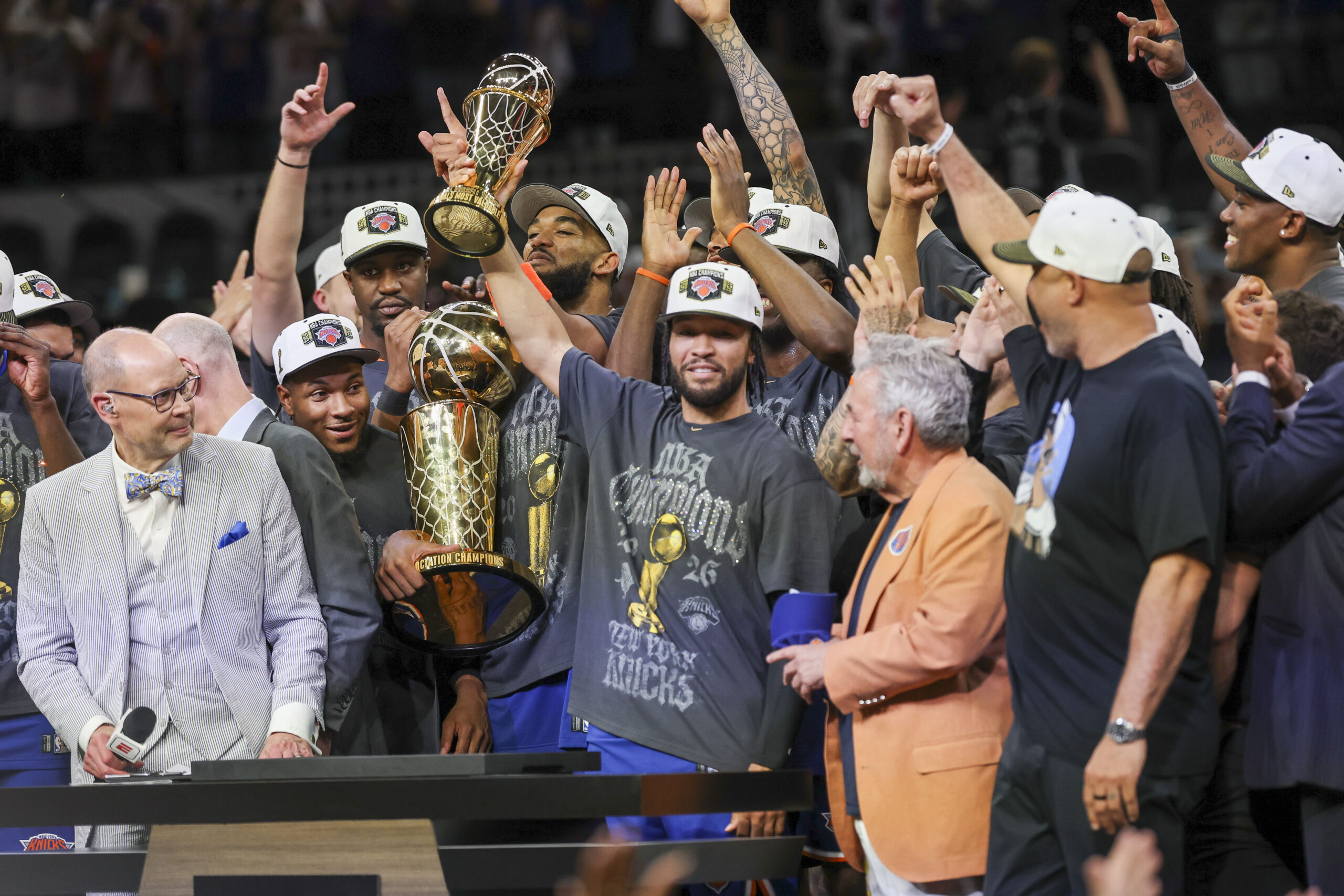
Instead of overhauling a roster that had just delivered the franchise’s first championship in 53 years, New York doubled down on continuity.

The Knicks retained Landry Shamet, Jose Alvarado, Jordan Clarkson and Mohamed Diawara, reinforcing a bench that played an important role throughout last season’s title run. It wasn’t a move designed to dominate social media or sports talk shows. It was designed to maximize a championship window while operating within strict financial limitations.

Sometimes, the smartest offseason isn’t the one everyone notices immediately.

Continuity became New York’s biggest offseason acquisition

The Knicks entered the summer from a position few franchises enjoy.

Their starting lineup remained intact, featuring Jalen Brunson, Karl-Anthony Towns, Mikal Bridges, OG Anunoby and Josh Hart—a core that has already proven it can win at the highest level. With approximately $191 million already committed to those cornerstone players over the coming seasons, significant roster changes at the top simply weren’t realistic.

Financial flexibility also remained limited.

Ownership’s commitment to staying below the NBA’s second apron meant New York couldn’t afford to chase expensive free agents without compromising the long-term health of the roster. Rather than forcing a move for the sake of making headlines, the front office identified the area where it could still create an advantage.

That area was the second unit.

Keeping familiar contributors wasn’t merely about loyalty. It was about preserving chemistry, maintaining role clarity and ensuring Mike Brown wouldn’t need to rebuild his rotation from scratch after guiding the franchise to a championship in his first season.

Every returning reserve understands the system, knows what is expected and complements the stars rather than competing with them for touches.

That level of continuity is difficult to quantify, but championship teams consistently benefit from it.

Depth could be the difference between repeating and falling short

Defending an NBA title is rarely about replicating what worked the previous season.

It is about surviving the inevitable injuries, fatigue and adversity that come with an 82-game schedule before navigating four demanding playoff rounds.

That’s where depth becomes indispensable.

Jose Alvarado brings relentless defensive pressure and infectious energy, often changing the pace of games without needing to dominate the stat sheet. Landry Shamet remains one of the roster’s most reliable floor spacers, creating valuable room for Brunson and Towns to operate offensively.

Jordan Clarkson gives Mike Brown another experienced shot creator capable of carrying stretches with the second unit, while Mohamed Diawara represents the organization’s developmental upside, possessing the athletic tools to emerge as a meaningful contributor when opportunities arise.

Each player fills a clearly defined role.

Collectively, they give the Knicks something equally important: stability.

That stability becomes even more valuable considering the strengthened competition awaiting New York. Philadelphia dramatically reshaped its roster by adding LeBron James and Jaylen Brown. Boston remains among the Eastern Conference’s elite despite offseason changes, and several other contenders have upgraded in hopes of dethroning the defending champions.

The Knicks know their stars will determine how high their ceiling remains.

But maintaining that ceiling over an entire season depends on what happens when those stars head to the bench.

Leon Rose understood there were no realistic opportunities to improve one of the NBA’s best starting lineups. Instead, he focused on protecting the supporting cast that helped transform New York from a contender into a champion.

It may not have generated the biggest headlines of the offseason.

If the Knicks are still playing deep into June next year, however, it may ultimately be remembered as the decision that gave them their best chance to raise another Larry O’Brien Trophy.

Continue Reading

Knicks News

The Knicks’ $12.4 Million Gamble Could Decide Whether They Repeat as NBA Champions

Published

on

The New York Knicks are betting on Landry Shamet, Jose Alvarado and Mohamed Diawara to strengthen their bench while staying below the second apron. Their development could determine New York’s title defense.

Championship teams are usually remembered for their superstars.

Jalen Brunson’s brilliance, Karl-Anthony Towns’ versatility and OG Anunoby’s defensive heroics will dominate the headlines once again as the New York Knicks begin their quest to defend the franchise’s first NBA title in more than half a century. Yet the success of their repeat bid may ultimately depend on a far less glamorous storyline.

Instead of making splashy additions this summer, New York doubled down on financial discipline.

Determined to remain below the NBA’s restrictive second apron, the front office resisted the temptation to overspend and instead invested approximately $12.4 million in a trio of complementary players: Landry Shamet, Jose Alvarado and Mohamed Diawara.

On paper, that isn’t the type of move that generates excitement across the league. In practice, however, it could become one of the defining decisions of the Knicks’ championship defense.

New York’s biggest offseason bet wasn’t a blockbuster trade

The departure of Mitchell Robinson created more than just a vacancy in the rotation.

New York lost one of its defensive anchors, an elite rebounder and an interior presence capable of changing games without needing the basketball. Replacing that production through a single signing was never realistic, especially with the organization committed to maintaining long-term financial flexibility.

Instead, president Leon Rose and the front office chose a different path.

Rather than spending heavily on one established veteran, the Knicks spread their resources across multiple role players, believing that depth, continuity and clearly defined responsibilities would outweigh the benefits of another headline-grabbing acquisition.

Each member of the trio fills a different need.

Jose Alvarado brings relentless defensive pressure, infectious energy and the ability to disrupt opposing guards the moment they cross half court. He may never become a prolific scorer, but his value has always been measured by hustle plays, momentum-changing steals and the intensity he injects into every possession.

Landry Shamet provides something equally important in today’s NBA: dependable perimeter shooting. His spacing forces defenses to stay honest and gives Brunson and Towns additional room to operate, particularly when second-unit lineups struggle to create offense.

Then there is Mohamed Diawara, perhaps the most intriguing player of the group.

The young forward remains largely unproven at the NBA level, but his athleticism, defensive versatility and long-term upside make him one of the organization’s most fascinating developmental projects. If he can translate his physical tools into consistent production, the Knicks may discover they have added far more than a rotational contributor.

Every reserve has a role, but one mistake could be costly

The challenge facing New York isn’t simply having a productive bench.

It’s asking affordable players to consistently perform above the expectations typically associated with their contracts.

That pressure becomes even greater considering how dramatically the Eastern Conference has changed.

Philadelphia strengthened an already dangerous roster by adding LeBron James and Jaylen Brown, creating perhaps the Knicks’ biggest obstacle in the conference. Boston, despite several roster changes, remains firmly in the championship conversation, while other contenders continue searching for ways to close the gap.

The Knicks still enter the season as defending champions, but repeating has become significantly more difficult.

That reality places enormous importance on role definition.

Alvarado doesn’t need to average 20 points per game. His job is to pressure opposing guards, speed up the pace and ensure the team’s defensive identity never disappears when the starters head to the bench.

Shamet must punish defenses from beyond the arc, forcing opponents to respect every possession and preventing second-unit offenses from becoming stagnant.

Diawara faces perhaps the biggest individual challenge. Whenever his opportunities arrive, he must prove he belongs on the floor during meaningful NBA minutes, not simply as a developmental prospect but as a trusted member of a championship rotation.

Mike Brown has already demonstrated that he isn’t afraid to lean on unexpected contributors. During last season’s championship run, players such as Shamet, Tyler Kolek and Ariel Hukporti all delivered important performances when called upon. That flexibility became one of New York’s greatest strengths throughout the playoffs.

The Knicks are betting they can repeat that formula without sacrificing financial flexibility.

It’s a calculated gamble.

If those three reserves embrace their roles and deliver consistent production, New York’s decision to prioritize depth over expensive additions could be viewed as another masterstroke by the front office. If they fail to provide reliable support, however, the pressure on Brunson, Towns and the rest of the starting lineup could become overwhelming over the course of an 82-game season.

The stars will always determine how far championship teams can go.

But for the Knicks, the road to another Larry O’Brien Trophy may ultimately be paved by three role players whose combined salaries barely attract attention—but whose performances could define an entire season.

Continue Reading

Tendenza

Copyright © 2017 Zox News Theme. Theme by MVP Themes, powered by WordPress.