Connect with us

Knicks News

Knicks Trade Twist: Could Scotty Pippen Jr. Be the Surprise Replacement for Deuce McBride?

Published

on

The Knicks could consider trading Miles McBride for Scotty Pippen Jr., gaining a cost-controlled playmaker but sacrificing shooting and playoff defense.

The New York Knicks’ failure to reach a contract extension with Miles “Deuce” McBride before the August 11 deadline has created uncertainty around one of their most valuable reserves. It does not guarantee a breakup, but it preserves the defending champions’ ability to include the guard in a trade before February’s deadline.

McBride is entering the final season of a three-year, $13 million contract and is due to earn approximately $3.9 million. After averaging 12 points while shooting 41.3% from three last season, he will likely command a significant raise in unrestricted free agency.

With New York trying to remain below the second apron, management must decide whether McBride is part of its long-term plans or a valuable trade asset who can address another roster need. One hypothetical proposal would send him to the Memphis Grizzlies in exchange for Scotty Pippen Jr.

Why Pippen could fit the Knicks’ financial plan

Pippen would provide New York with a younger and less expensive replacement. His salary is approximately $2.46 million for 2026-27, while the Knicks could retain him for the following season by exercising a team option worth roughly $2.79 million.

That additional year of control is the trade idea’s greatest attraction. Instead of risking McBride’s departure in free agency or committing to a more expensive extension, the Knicks would secure a rotation guard at a manageable price through 2027-28. 

Pippen has developed into a productive backup after going undrafted in 2022. During an injury-shortened 2025-26 season, he averaged 11.4 points and 4.7 assists for Memphis. Across his time with the Grizzlies, he has demonstrated an ability to create off the dribble, organize the second unit and generate steals by anticipating passing lanes. 

His playmaking would give the Knicks something different from McBride. Pippen is more comfortable operating as a traditional point guard, navigating ball screens and creating opportunities for teammates. That could help New York’s bench maintain its offensive structure whenever Jalen Brunson rests.

He has also improved as an outside shooter, reducing one of the concerns that followed him into the NBA. While he cannot completely replace McBride’s combination of volume and accuracy from beyond the arc, he has become reliable enough to prevent defenses from ignoring him.

Financially, a straight swap would reduce New York’s payroll and preserve flexibility. That matters for a roster already carrying expensive long-term contracts for Brunson, Karl-Anthony Towns, OG Anunoby and Mikal Bridges.

Why New York should hesitate before trading McBride

The proposal is intriguing, but it is not an obvious victory for the Knicks. McBride has already proved that he can perform in meaningful playoff games, defend larger guards and thrive without dominating possession. Those qualities are especially valuable alongside Brunson.

His shooting also makes him an easier fit within New York’s starting and closing lineups. McBride can space the floor, attack rotating defenses and guard the opponent’s most dangerous perimeter scorer. Pippen offers more natural playmaking, but his smaller frame could create limitations in certain postseason matchups.

The Knicks must also consider the presence of José Alvarado. Adding another undersized defensive point guard would increase ball-handling depth but might create redundancy. Moving McBride would leave New York with fewer options against bigger backcourts and place greater pressure on its wings.

Memphis would have reasons to hesitate as well. Pippen is cost-controlled for an additional season, whereas McBride could become an unrestricted free agent in 2027. The Grizzlies would need to believe that McBride’s superior shooting and defensive versatility justify accepting the increased financial risk.

There is also no indication that the two organizations are actively discussing this trade. It remains a theoretical framework inspired by McBride’s unresolved contract situation, not a reported negotiation.

The Knicks should therefore avoid moving McBride merely to escape his next contract. A championship team cannot evaluate every decision exclusively through the salary-cap sheet. Pippen would be a sensible target if New York prioritizes inexpensive playmaking, but McBride remains the more proven postseason fit.

Failing to agree on an extension does not necessarily mean the relationship is finished. It simply ensures that McBride will enter the season as both an important rotation player and one of the Knicks’ most movable assets.

AdvertisementAdvertisement

Knicks News

Landry Shamet Reveals the Unexpected Problem That Shook the Knicks in NBA Finals Game 3

Published

on

Landry Shamet explains how an altered routine and the unusual atmosphere at Madison Square Garden affected his preparation for NBA Finals Game 3.

Playing at Madison Square Garden should have given the New York Knicks a valuable advantage during the 2026 NBA Finals. For Landry Shamet, however, Game 3 felt surprisingly unfamiliar. The heightened security, media attention and altered transportation arrangements disrupted the routine he normally follows before taking the court in New York.

Shamet did not present those circumstances as an excuse for the Knicks’ uneven performance. His account nevertheless offers a revealing look at how the pressure surrounding a championship series can make even a home game feel like a road assignment.

Why Madison Square Garden did not feel like home

NBA shooters often build their preparation around precise habits. Meals, rest, treatment, transportation and warm-up times are carefully organized to help them enter a game with the right physical and mental rhythm. Shamet’s usual routine includes eating at 4 p.m. and taking a 90-minute nap beforehand.

That structure disappeared ahead of Game 3. Instead of following his normal schedule and traveling to Madison Square Garden independently, Shamet had to reach the arena on the team bus. The change may sound minor, but it removed the sense of control that players attempt to preserve during the most pressurized portion of the season.

“Game 3 was so weird for me because I’m in New York, but it was not my home routine,” Shamet explained. “I’m going to the Garden on a bus? I don’t do that.”

The extraordinary attention surrounding the contest, intensified by President Donald Trump’s attendance, resulted in an atmosphere unlike an ordinary Knicks home game. Shamet acknowledged that the disruption contributed to his anxiety and made preparation more complicated.

New York’s uncomfortable opening suggested that the team never fully settled into the occasion. The Knicks committed two poor turnovers in the first two minutes and trailed by 11 points at the end of the opening quarter. Those mistakes cannot be attributed solely to a modified routine, but Shamet’s comments help explain why the hosts appeared unusually tense.

Did the road team have an advantage in the Finals?

Shamet’s most interesting observation concerned the potential benefits of playing away from home. Road teams generally deal with hostile crowds and unfamiliar surroundings, yet their preparation can occasionally be more controlled. Players remain together, follow an established itinerary and operate without many of the additional obligations that accompany a major home event.

The visiting team can therefore approach the night as a conventional road game. The host, meanwhile, must manage increased ticket requests, family commitments, media responsibilities and the emotional weight of performing in front of its own supporters. During the NBA Finals, those distractions become even greater.

The results of the series strengthened Shamet’s argument. The road team won at least four games in the Finals for the first time since 2019 and came close to completing an extraordinary sweep of victories away from home. Rather than providing consistent protection, home court became another variable the players had to manage.

Shamet’s experience also illustrates how fine the margins are at championship level. Preparation does not guarantee a successful shooting night, but disrupting a familiar process can affect concentration before the opening tip. For a role player whose opportunities may be limited to only a few possessions, even a small increase in tension can carry significant consequences.

Game 3 will be remembered primarily for what happened on the court. Shamet’s account reveals the hidden challenge behind it: on the biggest stage of his career, playing at home did not feel like being home at all.

Continue Reading

Knicks News

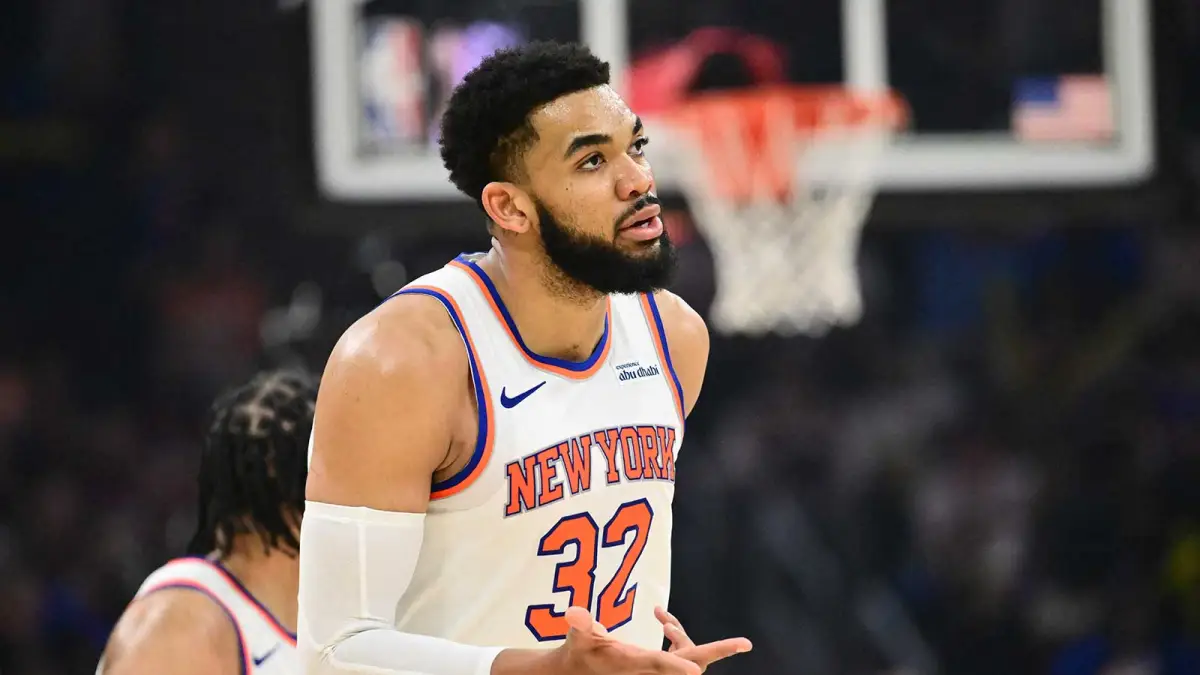
Karl-Anthony Towns Reveals the Knicks’ Hidden Plan Behind OG Anunoby’s Miracle Shot

Published

on

Karl-Anthony Towns reveals the Knicks’ original plan behind OG Anunoby’s miraculous game-winner in Game 4 of the 2026 NBA Finals.

OG Anunoby’s game-winning basket in Game 4 of the 2026 NBA Finals instantly became one of the most unforgettable plays in New York Knicks history. It pushed the franchise closer to its first championship in 53 years and transformed Madison Square Garden into a scene of pure disbelief.

Yet the sequence apparently unfolded very differently from the way Mike Brown and his staff originally designed it. According to Karl-Anthony Towns, Anunoby was not supposed to be the primary target on the decisive possession. The Knicks initially wanted to put the ball in the hands of their All-Star center.

The Knicks originally designed the play for Towns

Towns explained that the final action was intended to exploit the mismatch created by San Antonio’s defensive alignment. Victor Wembanyama had followed Jalen Brunson toward the perimeter, while the smaller Devin Vassell was responsible for containing Towns near the basket.

On paper, the matchup gave New York a clear advantage. Towns possessed the size and strength to establish position against Vassell, receive the inbound pass and attempt a close-range finish. San Antonio recognized the danger, however, and adjusted before the ball entered play.

De’Aaron Fox abandoned the inbounder to provide additional coverage on Towns. The second defender effectively removed New York’s first option, making a direct pass toward the center far too risky. What had started as a set designed to create an interior opportunity suddenly required an improvised solution.

That adjustment left Anunoby with the space necessary to attack the ball. Rather than forcing the original read, the Knicks reacted to the defensive pressure and turned a broken sequence into the defining moment of the series.

Towns was ready to finish the play if Anunoby missed

Anunoby’s airborne finish was not the only possible ending. Towns revealed that he had already prepared to clean up the possession if the attempt bounced away from the rim.

“I was going to dunk it,” Towns said. “I seen OG flying in the sky and I’m like, ‘All right, well, if he tries to tip the ball back in and it goes long and it goes off the front rim, I’m going to dunk it back in.’”

The detail provides a new perspective on a play remembered primarily for Anunoby’s athleticism and timing. While OG attacked the pass, Towns remained underneath the basket, reading its trajectory and positioning himself for a potential second effort. Had the first touch failed, New York might still have had another opportunity to win.

Instead, Anunoby completed the play himself and created an image that will remain attached to the Knicks’ championship forever. Towns’ account does not diminish that achievement. It makes the moment even more remarkable: the play broke down, San Antonio neutralized the intended target and New York still found a way to score.

Championship teams are often separated by their ability to survive when the original plan disappears. On this occasion, Towns attracted the defense, Anunoby recognized the opening and the Knicks converted chaos into history.

Continue Reading

Knicks News

Knicks Schedule Bombshell: Ring Night Is Only the Beginning of a Brutal Title Defense

Published

on

The Knicks’ 2026-27 schedule features a historic Ring Night, an NBA Finals rematch, brutal December travel and major rivalry games.

The New York Knicks now have the complete roadmap for their championship defense. The 2026-27 NBA schedule combines a historic opening night, marquee holiday games, demanding road stretches and an unforgiving NBA Cup group. Two December dates remain dependent on the Cup results, but the larger picture is already clear: the reigning champions will be tested early, often and under an intense national spotlight.

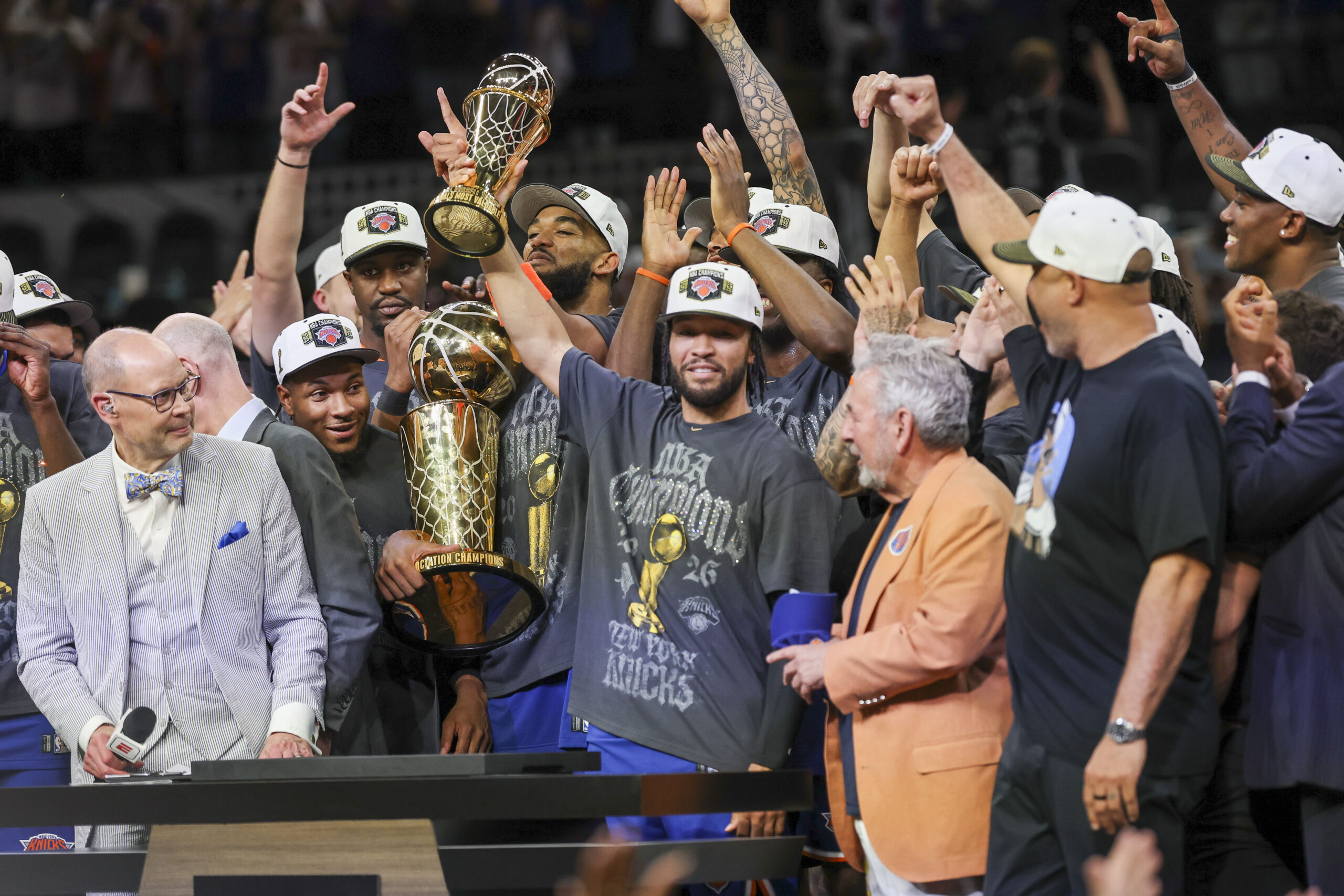
New York opens its season at Madison Square Garden on October 20 against the rebuilt Philadelphia 76ers. Before the basketball begins, the Knicks will raise their first championship banner since 1973 and receive the rings earned during their memorable title run. The ceremony alone makes this one of the most anticipated regular-season nights in franchise history.

Philadelphia adds even more intrigue. LeBron James and Jaylen Brown are expected to make their 76ers debuts alongside Joel Embiid and Tyrese Maxey, immediately presenting New York with a high-profile examination of its championship credentials. The meeting will also renew a postseason rivalry shaped by two Knicks series victories over Philadelphia in the previous three years. 

December could define the Knicks’ championship defense

Ring Night will command the most attention, but December may reveal much more about the Knicks’ ability to repeat. New York moves from its longest homestand—five consecutive games at Madison Square Garden in late November—into a difficult period dominated by travel.

The uncertainty created by the NBA Cup makes that portion of the calendar particularly challenging. Depending on how far the defending Cup champions advance, additional knockout games could be inserted before a demanding sequence that sends New York through Miami, Houston, New Orleans, Washington and Cleveland. A run to the final in Indianapolis could leave the Knicks away from Madison Square Garden for an unusually long period.

That stretch will test more than talent. Mike Brown must manage minutes, protect the health of his veteran core and keep the rotation productive while the team repeatedly changes cities and time zones. The Knicks will also face 12 back-to-backs across the season, including difficult combinations involving Boston, Miami, Detroit and Toronto.

Christmas Day provides a spectacular interruption. The San Antonio Spurs return to Madison Square Garden for a rematch of the 2026 NBA Finals, giving Victor Wembanyama and his teammates their first opportunity to answer New York’s five-game championship triumph. The noon tipoff will be one of the league’s showcase events. 

Only five days later, the Knicks begin another major trip. Games in Utah and Phoenix are followed by visits to Denver, Portland, Golden State and Sacramento. The combination of altitude, distance and consecutive late starts represents one of the most physically demanding sections of the schedule.

The travel does eventually become more manageable. New York has only five road back-to-backs, while several of its consecutive-night assignments either begin or end at Madison Square Garden. That does not eliminate the strain, but it should reduce some of the disruption associated with repeated flights.

Rivalries, returning faces and national attention fill the calendar

The Knicks’ NBA Cup defense begins with an extremely competitive group. New York visits Philadelphia on October 30 and Indiana on November 13 before hosting Cleveland and Miami around Thanksgiving. The Heat game will introduce Madison Square Garden to their new superstar, Giannis Antetokounmpo, while the trip to Indiana renews one of the Eastern Conference’s most emotional rivalries.

Several former Knicks will also return to New York wearing different uniforms. Ariel Hukporti is scheduled to receive his championship ring as a member of the 76ers on opening night. Jeremy Sochan returns with Portland in November, while Trey Jemison III comes back with Toronto in January.

The most emotional reunion may arrive on March 14, when Mitchell Robinson visits Madison Square Garden with the Boston Celtics. Other familiar faces expected in New York include Julius Randle, RJ Barrett, Immanuel Quickley, Obi Toppin, Isaiah Hartenstein, Kristaps Porzingis and Quentin Grimes.

Beyond those reunions, the schedule contains several games capable of shaping the Eastern Conference hierarchy. The first road contest in Boston, meetings with last season’s conference-leading Detroit Pistons and repeated clashes with Philadelphia will provide immediate evidence of whether the Knicks have maintained their edge.

The February 3 game in Detroit carries additional significance because it will be the second NBA Pioneers Classic, an event created to honor the first Black players who integrated the league in 1950. The March visit to San Antonio, meanwhile, will be the final regular-season rematch of the most recent NBA Finals. Both games have been placed on national television as the league makes New York a central part of its programming.

The Knicks’ schedule offers few comfortable stretches, but that comes with being champions. Opponents will treat New York as a measuring stick, national networks will showcase its biggest games and every difficult road trip will be examined for signs of vulnerability. Ring Night celebrates what the Knicks accomplished. Everything that follows will determine whether they can do it again.

Continue Reading

Tendenza

Copyright © 2017 Zox News Theme. Theme by MVP Themes, powered by WordPress.