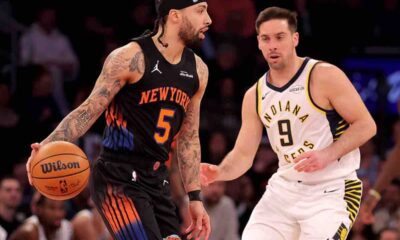
Miles McBride remains a valuable part of the New York Knicks, but his inconsistent NBA Finals and a crowded backcourt could force him to earn every minute during the 2026-27 season.
Championship teams are built on competition.
Not only against opponents, but within their own locker room.
That internal competition has become one of the defining characteristics of the New York Knicks under head coach Mike Brown. While continuity has been a major theme of the defending champions’ offseason, the battle for playing time may be fiercer than ever, particularly in one of the deepest backcourts in the NBA.
Few players illustrate that reality better than Miles McBride.
The veteran guard has earned the trust of the coaching staff through years of relentless defense, improved perimeter shooting and unwavering professionalism. Yet his postseason experience also demonstrated an important truth about Brown’s coaching philosophy: reputation alone will never guarantee minutes.
Every player must continue proving their value, regardless of past contributions.
The NBA Finals revealed how competitive New York’s rotation has become
For much of the playoffs, McBride remained a dependable part of New York’s rotation.
Across the first three postseason rounds, he averaged approximately 19 minutes per game and surpassed the 20-minute mark seven times in 14 contests. During that stretch, he contributed around seven points per game while knocking down 43 percent of his three-point attempts, providing valuable floor spacing and defensive intensity whenever Mike Brown turned to his bench.
Those performances reinforced why McBride has become such a respected role player.
However, the NBA Finals presented a dramatically different challenge.
As every possession carried greater importance, Brown shortened his rotation and leaned heavily on players who were producing consistently. McBride struggled to find his offensive rhythm during the series, failing to convert any of his eight field-goal attempts over the final three games.
His playing time reflected that decline.
Instead of maintaining his regular workload, his minutes dropped to roughly nine per game during the closing stretch of the Finals as Brown adjusted the rotation in search of the combinations that gave New York its best chance to secure the championship.
That decision was not necessarily an indictment of McBride.
Rather, it reflected the ruthless reality of championship basketball, where coaches cannot afford patience if another lineup offers a better opportunity to win.
McBride has the talent to respond, but consistency will be essential
There is important context surrounding McBride’s postseason struggles.
During a recent appearance on Knicks Film School, the guard revealed that he had played through significant discomfort after returning from the sports hernia surgery that sidelined him for much of February and March. Although he was medically cleared, he acknowledged that he never felt fully recovered during the playoffs.
That explanation provides valuable perspective.
Injuries can significantly affect rhythm, explosiveness and shooting mechanics, particularly for players whose roles depend on defensive intensity and confidence from beyond the arc. It is entirely reasonable to believe that a healthier McBride could return to the form he displayed before the postseason.
Even so, the competition around him has only intensified.
Jose Alvarado offers relentless defensive pressure and traditional point guard skills. Landry Shamet has become one of New York’s most reliable perimeter shooters and an excellent point-of-attack defender. Jordan Clarkson supplies instant offense whenever the second unit needs scoring, while Tyler Kolek continues developing as another intriguing option capable of handling backup guard responsibilities.
That depth gives Mike Brown tremendous flexibility.
Throughout last season, Brown repeatedly demonstrated that he is willing to experiment with lineups during the regular season and reward whichever players are performing at the highest level. Alvarado himself spent significant time outside the regular rotation before re-emerging as an important contributor during the playoffs, proving that roles can change quickly depending on performance and team needs.
McBride enters the new season fully aware of that reality.
If his outside shot remains consistent, if he continues expanding his ability to create offense off the dribble and if he maintains his reputation as one of the Knicks’ toughest perimeter defenders, there is little doubt he will remain an integral member of the rotation.
If those areas stagnate, however, the margin for error becomes much smaller.
With so many capable guards competing for minutes, a prolonged shooting slump or defensive inconsistency could result in a noticeable reduction in playing time.
That is not a weakness of New York’s roster.
It is one of its greatest strengths.
Championship teams thrive because every player understands that minutes must be earned rather than expected. The Knicks possess enough depth to adjust seamlessly from game to game, allowing Mike Brown to prioritize production over reputation.
For Miles McBride, that creates both a challenge and an opportunity.
His place on the roster is secure, but his role will ultimately be determined by what he produces on the court. If he responds with the same determination that has defined his career, the Knicks could once again find themselves relying on one of their most dependable two-way guards when the games matter most.